In the Antalya plain, water and energy are two sides of the same cost line. Citrus groves around Finike and Kumluca, vegetable fields in Serik and Aksu and greenhouse clusters across the province depend on boreholes and pumps that run hardest in the hottest, sunniest months. Where those pumps are driven by diesel generators or long, expensive grid extensions, solar irrigation turns Antalya solar energy directly into pumped water, cutting operating costs and removing fuel logistics from the farm.
Antalya Solar Energy Co. engineers solar pumping systems as hydraulic systems first and electrical systems second. A pump that is perfectly matched to its borehole and irrigation network will deliver more water per kilowatt-peak than an oversized array feeding the wrong pump. This page explains how we get that match right.
How solar pumping turns Antalya solar energy into water
A solar pumping system connects a PV array to a pump drive, usually a solar pump inverter with variable-frequency control. As irradiance rises in the morning, the drive starts the pump at low speed and increases it as more power becomes available, extracting maximum power from the array at every moment through MPPT control. At midday the pump runs at or near full speed; in the late afternoon it slows down again and stops at a defined minimum frequency.
The key insight is that the system stores water, not electricity. Instead of charging batteries, it fills a tank, pond or reservoir, or delivers directly into a drip network during daylight hours. This makes solar pumping one of the simplest and most robust ways to use solar energy in agriculture.
Hydraulic sizing: starting from water, not watts
We size every irrigation system from the hydraulic requirement backwards. The table below lists the data we collect and why each parameter matters:
| Input parameter | Why it matters |
|---|---|
| Static and dynamic water level | Defines the lift height and how the level drops during pumping |
| Borehole depth and diameter | Limits pump size and installation depth |
| Daily water requirement in peak season | Sets the volume the system must deliver on a typical summer day |
| Pipe lengths, diameters and elevation | Determines friction losses and the total dynamic head |
| Irrigation method and pressure | Drip, sprinkler or flood irrigation require different operating pressures |
| Existing pump and motor data | Shows whether the current pump can be retained with a solar drive |
From these figures we calculate the total dynamic head and the hydraulic power required, then select a pump operating efficiently at that duty point. Only then do we size the array, normally with a margin above the pump motor rating so the pump reaches full speed early in the day and keeps running into the afternoon.
Choosing the pump drive and motor
Many farms already own a reliable three-phase submersible or surface pump. In most cases it can be retained: a solar pump inverter converts the array's DC output into variable-frequency AC for the existing motor. Where the pump is old, oversized or inefficient, replacing it can reduce the required array size noticeably. For small, deep boreholes, high-efficiency DC or permanent-magnet pumps are an option. We compare these routes in the proposal, including dry-run protection, tank level switches and remote control functions.
Storage strategy: tanks and reservoirs instead of batteries
Irrigation demand in Antalya is concentrated in the long, dry season from spring to autumn, the same period in which solar energy in Antalya is most abundant. Batteries are rarely needed. A storage tank or lined pond sized for one to two days of peak demand provides a buffer for cloudy days and allows gravity-fed or booster-pump irrigation in the evening, when evaporation losses are lower. Water storage costs a fraction of battery storage and lasts for decades without capacity loss.
Off-grid pumping or grid-connected agricultural plant?
Two architectures are possible. A direct-drive off-grid system powers the pump only from the array and is ideal for fields without a grid connection or where diesel is the current energy source. A grid-connected agricultural plant serves farms that already have an electricity subscription: the array supplies the pump and other farm loads, while the grid covers night-time demand and surplus energy is settled under the unlicensed generation rules. Because the regulatory provisions on netting and surplus settlement have changed over time, we check the current EPDK framework before recommending a grid-connected design. For broader farm energy needs, see our agricultural solar service.
Applications across the Antalya plain
- Orchard irrigation: citrus, pomegranate and avocado plantations with drip systems fed from boreholes.
- Field vegetables: seasonal crops where pumping demand peaks between May and September.
- Greenhouse supply: filling header tanks for fertigation systems in greenhouse clusters.
- Livestock watering: remote troughs and storage tanks on grazing land without a grid connection.
- Pond and reservoir filling: daytime pumping into storage for distribution by gravity or booster pumps.
Reference: 5.5 kW ground-mounted irrigation array
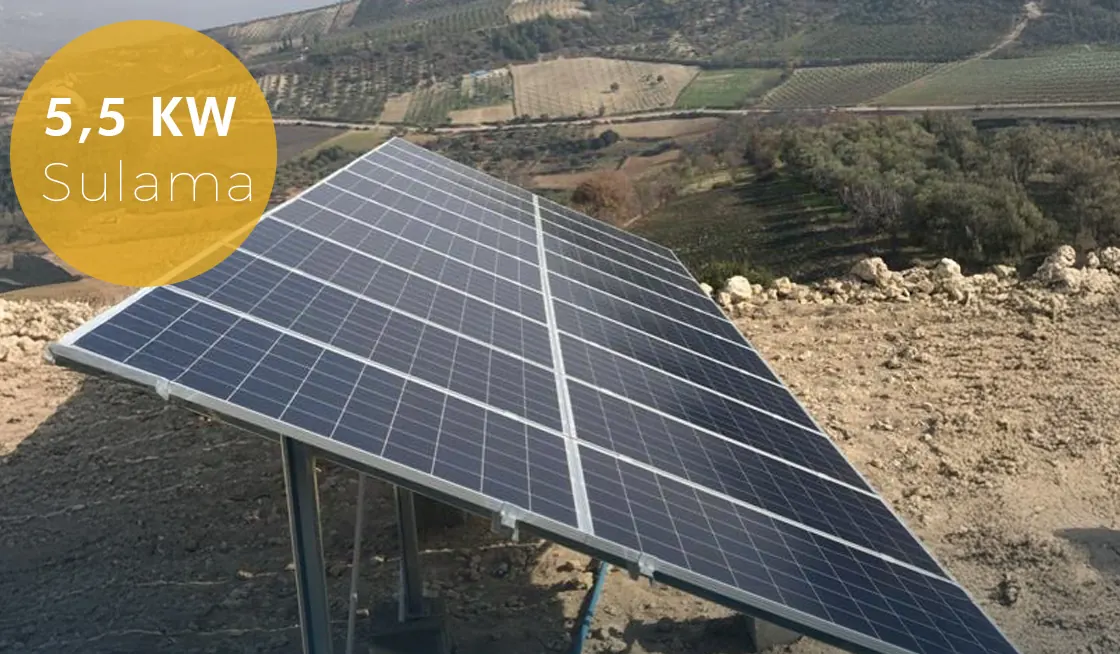
One of our irrigation references is a 5.5 kW ground-mounted solar array supplying a field irrigation system. The array stands on a fixed frame in the field next to the pump, with the drive mounted in a protected enclosure. It replaced fuel-dependent pumping with a system that starts automatically every morning and requires little more than periodic cleaning and inspection. The same engineering approach scales to larger pump stations and is integrated into our off-grid systems where pumping is one of several loads on a remote site.
Installation, commissioning and seasonal maintenance
- Site visit and data collection: borehole data, water requirement, pipe routes and array location.
- Design: hydraulic calculation, pump and drive selection, array layout and mounting structure.
- Installation: ground frame or roof mounting, cabling, drive enclosure, level sensors and protection.
- Commissioning: flow and pressure measurement at different irradiance levels, dry-run and tank-level tests.
- Seasonal service: pre-season inspection, module cleaning, cable and connection checks, and drive parameter review.
Exact system size and cost are confirmed after the site survey, once hydraulic data and the installation location are known. Groundwater use itself is subject to the relevant water permits, which remain the responsibility of the well owner; we design the energy system around the permitted extraction.