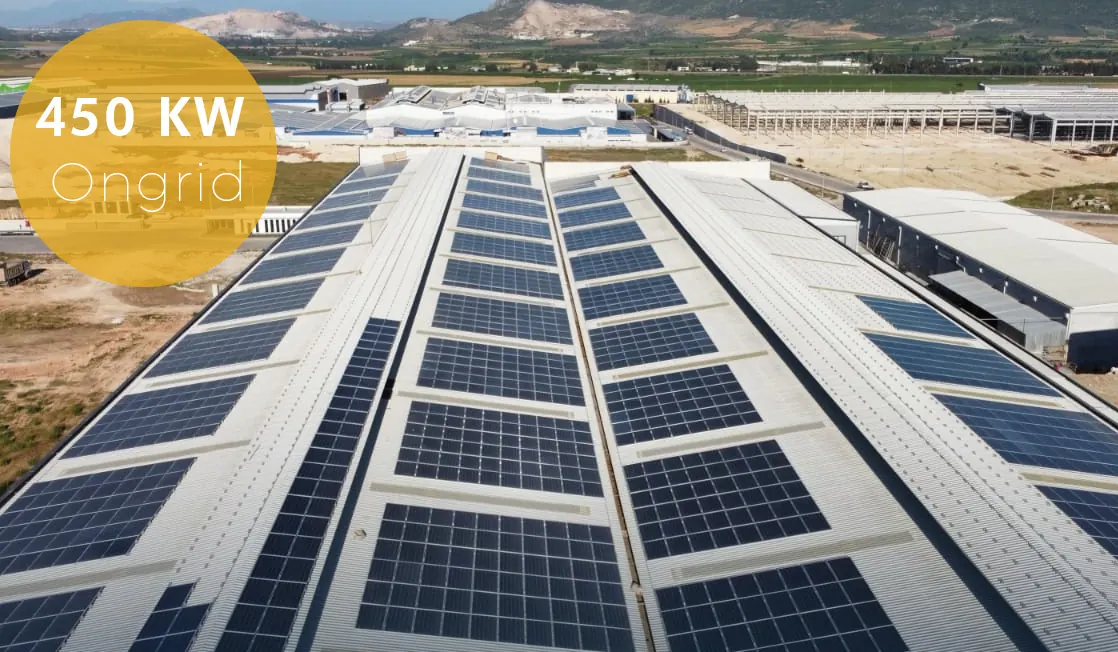
An on-grid solar plant works in parallel with the public distribution network. It feeds your building first, draws from the grid whenever demand exceeds generation, and passes surplus energy back to the network under the applicable settlement rules. For factories, hotels, cold stores, offices and homes with an existing electricity subscription, on-grid solar energy in Antalya is usually the configuration with the lowest investment per kilowatt-hour and the most straightforward operation.
Every grid-connected Antalya solar energy plant we have built, from a 3.3 kW tiled residential roof to a 4.5 MW industrial rooftop, follows the same principle: the engineering has to satisfy the distribution company as rigorously as it satisfies the client's business case. This page explains how we approach both.
How on-grid Antalya solar energy plants work
Modules convert sunlight into direct current, which string inverters convert into grid-synchronised alternating current. That AC output is connected to your low-voltage main distribution board or, for larger plants, to a dedicated transformer and medium-voltage switchgear. Your loads always take solar energy first, because it is physically the nearest source. When generation exceeds demand, the excess flows through the meter to the grid; when demand exceeds generation, the grid supplies the difference without any switching.
For safety, grid-tied inverters stop exporting within fractions of a second if the grid fails. This anti-islanding behaviour protects line workers, but it also means a standard on-grid plant does not provide backup power. Clients who need continuity during outages should consider a hybrid system with battery storage.
The regulatory framework: unlicensed generation in Turkey
Most on-grid plants in Turkey are built under the Unlicensed Electricity Generation Regulation (Lisanssız Elektrik Üretim Yönetmeliği), supervised by the Energy Market Regulatory Authority (EPDK). The regulation allows consumers to generate their own electricity without a generation licence, provided the plant is linked to their consumption and connected according to the distribution company's technical conditions.
The details matter and they change. Over recent years, rules on maximum capacity relative to connection power and consumption, the period over which generation and consumption are netted (mahsuplaşma), and the price at which surplus energy is settled have all been amended. A business case built on outdated assumptions can overstate returns. We therefore check the provisions in force at the time of application and model your plant on that basis, and we recommend that clients review the current EPDK rules with us before committing to a final capacity.
From application to energisation
The administrative path runs in parallel with engineering and procurement. For a typical commercial plant it looks like this:
- Pre-feasibility: review of invoices, connection power, transformer capacity and the subscriber details on which the application will be based.
- Application to EDAŞ: submission of the connection request to the regional distribution company with the required documents and single-line diagram.
- Connection opinion and agreement: the distribution company assesses network capacity, issues its opinion and, once conditions are met, signs the connection agreement.
- Project approval: the electrical design is submitted for approval in line with the applicable procedures.
- Installation and testing: construction, insulation and continuity tests, inverter configuration and protection settings.
- Acceptance and metering: TEDAŞ or the authorised body carries out acceptance, the bidirectional metering is put in place and the plant is energised.
Timelines differ between distribution regions and with plant size, so we provide a milestone schedule at contract stage and update it as each approval comes through.
Sizing an on-grid plant against consumption
The most valuable kilowatt-hour is the one you consume yourself, because it displaces energy you would otherwise buy at your full tariff, including network and tax components. Surplus energy is usually worth less. For that reason we size commercial on-grid plants primarily against self-consumption: we compare an hourly generation profile for your roof with your load profile and calculate how much output is used on site at different capacities.
For a factory with steady weekday production, a large share of generation can be consumed directly. A hotel in Belek or Side has strong seasonal cooling loads that align well with summer generation. An office with weekend closures has a lower self-consumption ratio. The optimum capacity is different for each, and it is always bounded by the regulatory limits and the grid capacity approved for the site.
Electrical design: inverters, protection and metering
| Component | Role in the plant | Our design approach |
|---|---|---|
| String inverters | Convert DC to grid-synchronised AC | Multiple MPPT inputs for complex roofs; distributed units for redundancy |
| DC cabling | Connects strings to inverters | UV-resistant cable sized to limit losses, protected routes on roofs |
| AC protection | Isolation, overcurrent and surge protection | Coordinated with the existing main board and transformer |
| Grid protection | Disconnects the plant on abnormal grid conditions | Settings per distribution company requirements |
| Metering and monitoring | Records import, export and generation | Bidirectional meter plus inverter and consumption data in one platform |
Where a site's connection conditions restrict export, we can configure export limitation so the plant reduces output rather than exceeding the agreed limit. This keeps the installation compliant while maximising self-consumption.
On-grid reference plants
- Industrial rooftops: on-grid plants of 450 kW, 860 kW, 970 kW, 1.3 MW and 4.5 MW on manufacturing and logistics buildings.
- Ground-mounted plants: on-grid field installations of 680 kW and 2.4 MW, including inverter stations and medium-voltage connection works.
- Residential: a 3.3 kW on-grid system on a tiled roof, built with the same documentation standard as our industrial work.
Read more about the specific engineering of rooftop plants and ground-mount plants.
Monitoring, O&M and performance ratio
After energisation, every plant we build for solar energy in Antalya is connected to a monitoring platform that records inverter output, string data and, where metering allows, on-site consumption. Under an O&M contract our engineers review alarms, compare generation with expected yield for the measured irradiance and track performance ratio over time. A falling PR is often the first sign of soiling, a failed string or an inverter fault. Acting on it early keeps the plant close to its design output and protects equipment warranties.
Is on-grid the right choice for your site?
On-grid is the right default for most connected sites with significant daytime consumption. If outages disrupt your operations, evening demand dominates or surplus energy has little value under current rules, a hybrid configuration may serve you better. If there is no affordable connection at all, consider off-grid solar. Our feasibility study compares these options on the same data, so the decision rests on numbers rather than preference.