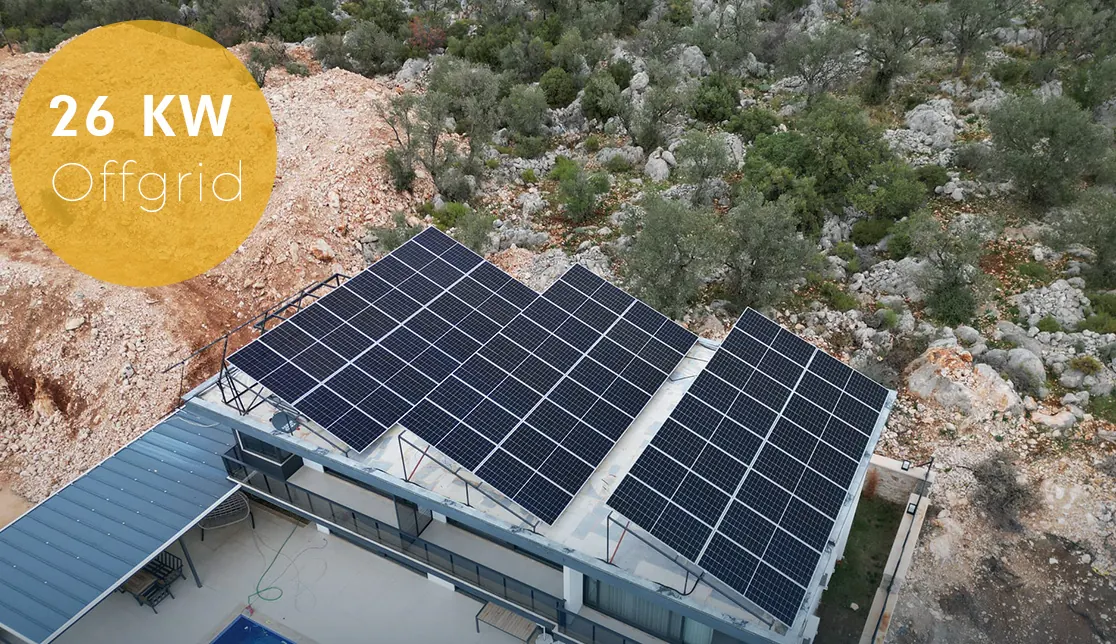
Villas and detached homes along the Antalya coast have a distinctive energy profile: long, hot summers with heavy air-conditioning use, swimming pools that need daily filtration, and often a mix of permanent residents and seasonal occupancy. Residential solar energy in Antalya can cover a large share of that demand, add resilience during power cuts and, in remote locations, replace the grid altogether.
Although our core business is commercial and industrial EPC, Antalya Solar Energy Co. designs residential systems with exactly the same engineering discipline: measured consumption, a site-specific yield model, proper protection and complete documentation. The result is a home system that behaves predictably for decades, not a set of panels installed in a day and forgotten.
The energy profile of an Antalya villa
Household consumption in the region typically rises sharply from June to September, driven by cooling and pool pumps, and falls in the mild winter months. Solar generation follows a similar seasonal curve, which is why Antalya solar energy fits household demand so well. The daily pattern matters too: a family at home during the day uses solar energy directly, while a household that is out at work shifts most consumption into the evening. We look at both patterns before recommending a size or configuration.
Properties used as holiday homes or rented out in summer add another dimension. Consumption may be close to zero for months and then jump when guests arrive. In such cases we design for the occupied season and pay particular attention to standby consumption, remote monitoring and the behaviour of the system when nobody is on site.
On-grid, hybrid or off-grid: choosing your Antalya solar energy system
| Configuration | Best suited to | Trade-offs |
|---|---|---|
| On-grid | Connected homes with good grid reliability | Lowest cost per kWh; no supply during power cuts |
| Hybrid with battery | Homes with evening demand or frequent outages | Backup and load shifting; higher investment |
| Off-grid | Properties without an affordable grid connection | Full autonomy; requires careful sizing and storage |
We compare these options on your actual consumption data during the free survey and recommend the configuration that fits both your budget and your priorities.
Residential references from our portfolio
- 3.3 kW on-grid system on a tiled roof, a compact grid-tied installation for a family home.
- 15 kW hybrid systems in Konyaaltı (two installations), Kemer and Döşemealtı, combining self-consumption with backup.
- 7.7 kW off-grid seaside villa in Kaş, with component selection adapted to salt-laden coastal air.
- 26 kW off-grid systems for a detached house and for a villa with a pool, both running without any grid connection.
- 4.4 kW garden house and 2.2 kW compact off-grid units for properties used occasionally.
Commercial-grade engineering for private homes
A home solar system is small in kilowatts but no less demanding in engineering terms. Roof attachments must stay watertight for decades, string design must cope with chimneys, dormers and neighbouring trees, and protection devices must be coordinated with the existing household distribution board. We apply the same checklists we use on industrial roofs, from cable sizing to earthing and surge protection, and document the installation so any future service technician can understand it at a glance.
Equipment choice follows the same principles. We specify Tier-1 modules and inverters with warranty terms and local service support suited to a home system's long life, and we explain in the proposal which components carry which warranty, so you know exactly what is covered.
Roof and mounting options on Antalya homes
Tiled roofs are the most common in the region. Here we use roof hooks fixed beneath the tiles to the rafters, with rails mounted on top, so the tile covering remains intact and watertight. Flat concrete roofs, typical of many villas and apartment blocks, take tilted frames that are either anchored or ballasted, depending on the roof's waterproofing and load capacity. Where roof space is limited or the owner prefers, pergolas, carports or a small ground frame in the garden can carry the array while providing shade below.
Coastal locations from Kemer to Kaş call for extra care. Salt-laden air accelerates corrosion of fixings and connectors, so we use suitable stainless or coated components and enclosures with the right protection class. On exposed hillside plots, wind loads at roof edges and corners are calculated rather than estimated.
From survey to switch-on
- Free survey: roof inspection, shading assessment and review of twelve months of bills.
- Design and proposal: system size, layout, configuration and an indicative payback range.
- Grid application: for on-grid and hybrid systems, we prepare and submit the file to the distribution company.
- Installation: mounting, modules, inverter and protection devices, usually completed within a few days.
- Acceptance and commissioning: testing, meter procedures and energisation once approvals are complete.
- Handover: documentation, warranty records and set-up of the monitoring app.
For off-grid homes the sequence is simpler on the regulatory side, because no grid application is needed, but the design phase is more detailed: we calculate daily loads, peak power and battery autonomy for the least sunny weeks of the year.
Costs and payback for homeowners
The cost of residential solar energy in Antalya depends on capacity, roof type, configuration and whether batteries are included. Payback depends on how much of the generated energy you use yourself, your electricity tariff and the settlement rules for surplus energy in force when your system is connected, which have changed several times in recent years. We give you a realistic payback range based on your own bills and confirm exact pricing after the site survey, rather than quoting generic package prices.
Batteries change the calculation. They add investment but increase the share of solar energy used at home and provide backup during outages. For many households the deciding factor is not pure payback but comfort and security: keeping the refrigerator, lights, internet and pool pump running when the grid fails. We show both the financial and the practical side, so you can decide what matters most.
Living with a solar system: monitoring and care
Once your system is running, a monitoring app shows daily generation, consumption and, for hybrid systems, battery state of charge. Maintenance is modest: periodic cleaning, especially after dusty or pollen-heavy weeks, and an occasional inspection of fixings, cables and the inverter. Homeowners who prefer not to deal with any of this can opt for a service plan, in which our team watches for alarms and schedules visits when needed.
If you plan to sell the property later, complete documentation helps. Our handover file includes the system layout, equipment data, test records and warranty documents, which gives a buyer or their surveyor a clear picture of the installation and its condition.