Not every site in Antalya can, or should, be connected to the grid. Hillside estates above Kaş, farm compounds on the edge of the Taurus foothills, telecom and monitoring stations, construction camps and agricultural pump houses often sit kilometres from the nearest medium-voltage line. Extending that line can cost more than the energy system itself and take months of approvals. For these locations, off-grid solar energy in Antalya is not a compromise but the most rational engineering answer.
Antalya Solar Energy Co. designs off-grid systems the way we design commercial plants: from a measured load profile, a defined autonomy requirement and a winter yield calculation. The result is an autonomous power system that delivers predictable energy every day of the year, documented and commissioned to the same standard as our commercial and industrial installations.
Where off-grid solar makes engineering sense
An off-grid system replaces a grid connection entirely. That makes it the right choice when one or more of the following conditions apply:
- No viable connection: the parcel is far from the distribution network, or the connection cost and lead time are disproportionate to the energy demand.
- Diesel replacement: a generator currently supplies the site, with fuel logistics, noise, maintenance and emissions that a solar-battery system can largely eliminate.
- Seasonal or remote use: holiday villas, mountain houses and garden properties that are occupied part of the year and need dependable power when they are.
- Technical sites: pumping stations, measurement equipment, security systems and site offices that require continuous low-to-medium power far from infrastructure.
Where a grid connection is available and affordable, an on-grid or hybrid system is usually more economical, because the grid absorbs seasonal imbalances that an off-grid battery bank must otherwise cover. Part of our feasibility work is to tell you honestly which architecture fits.
System architecture: array, inverter-charger and battery bank
A professional off-grid installation is built around four functional blocks, each sized against the others:
- PV array: monocrystalline modules mounted on the roof or on a ground frame, oriented and tilted to favour winter production rather than summer peaks.
- Charge control: MPPT charge controllers or a hybrid inverter-charger that extracts maximum power from the array and manages battery charging stages.
- Battery bank: lithium iron phosphate (LFP) modules with an integrated battery management system, chosen for cycle life, usable depth of discharge and thermal stability.
- Inverter and distribution: an off-grid inverter with sufficient continuous and surge rating to start pumps, compressors and motors, feeding a protected distribution board.
Getting the interaction right matters more than any single component. An undersized inverter will trip when a pool pump and air conditioners start together; an oversized array without enough storage will waste energy at noon and run short at night.
Sizing Antalya solar energy for autonomy: the winter design case
Summer in Antalya is generous, so off-grid systems rarely struggle in July. The design case is a sequence of short, cloudy days in December or January, when yield is lowest and lighting and heating loads are highest. We size the array to cover daily consumption under winter irradiance, and the battery bank to bridge a defined number of low-sun days. The table below shows how typical site profiles translate into system classes, based on our own reference installations.
| Site profile | Typical loads | Reference system | Design focus |
|---|---|---|---|
| Small cabin or technical shelter | Lighting, communications, small appliances | 2.2 kW off-grid | Low standby consumption, compact storage |
| Garden house | Lighting, refrigeration, garden pump | 4.4 kW off-grid | Pump start current, weekend usage peaks |
| Seaside villa | Household loads, air conditioning | 7.7 kW off-grid, Kaş | Coastal corrosion protection, evening load |
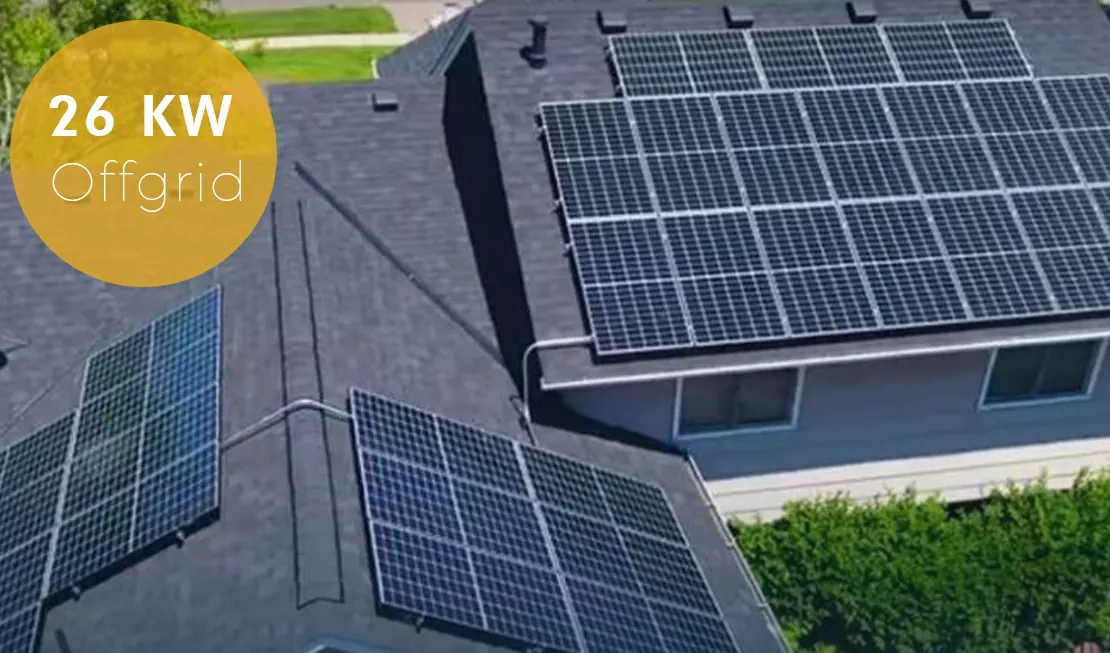
| Detached house or villa with pool | Full household, pool pump, cooling | 26 kW off-grid | Surge capacity, load scheduling, large storage |
| Farm or multi-building compound | Workshops, cold rooms, pumps | 60 kW off-grid with battery room | Three-phase supply, dedicated battery room |
Exact capacity, storage and cost are determined after a site survey, because roof orientation, shading from terrain and the client's usage habits change the numbers considerably.
Off-grid Antalya solar references from 2.2 kW to 60 kW
Our off-grid portfolio covers the full spectrum, from minimal autonomous units to systems that power an entire property:
- 26 kW off-grid detached house: a full-size household supply with no grid connection, designed for year-round residence.
- 26 kW off-grid villa with pool: engineered for pool filtration and high summer cooling demand, with load priorities set in the inverter.
- 7.7 kW seaside villa in Kaş: a coastal installation where salt-laden air dictated component selection and enclosure ratings.
- 60 kW off-grid system with battery room: our largest autonomous installation, with storage housed in a ventilated, dedicated room.
- 4.4 kW garden house and 2.2 kW compact system: right-sized solutions for occasional use, where simplicity and low maintenance matter most.
- 8.2 kW off-grid system in Döşemealtı: documented in one of our installation videos, showing the build sequence on site.
Battery rooms, safety and component placement
On larger systems, the battery bank is the heart of the installation and deserves its own engineering. We specify a dry, shaded and ventilated location, ideally a dedicated battery room as in our 60 kW reference, with controlled temperature, cable protection, DC isolation and clear labelling. LFP chemistry offers excellent thermal stability, but correct installation still determines lifetime: batteries kept cool and operated within the recommended state-of-charge window age noticeably more slowly.
Inverters and charge controllers are mounted away from direct sun, with clearances for cooling. On coastal sites from Kemer to Kaş, we pay particular attention to corrosion-resistant fixings and enclosure protection classes.
Generator integration and load management
For critical sites, we often integrate an existing or new generator with the inverter-charger. The generator starts automatically only when battery charge falls below a set threshold during extended cloudy periods, so run hours drop dramatically compared with a diesel-only site. At the same time, programmable load management can delay non-essential consumers such as pool pumps or water heaters until the battery is well charged, making the most of every kilowatt-hour the array produces.
Our delivery process for off-grid sites
- Load audit: we list every consumer, its power rating and daily operating hours, including seasonal loads such as air conditioning or irrigation.
- Autonomy definition: together we agree how many low-sun days the system must bridge and whether a generator forms part of the concept.
- Design and simulation: array, storage and inverter capacities are calculated against winter yield and peak power requirements.
- Installation: mounting, cabling, battery and inverter installation, protection devices and earthing.
- Commissioning and handover: functional testing under load, configuration of charging and load priorities, and training on the monitoring interface.
Lifecycle costs and long-term operation
An off-grid system carries no electricity bills, but it is not maintenance-free. Modules need periodic cleaning, connections should be checked and inverter firmware kept up to date, and the battery bank is the component most likely to need replacement during the life of the array. We explain expected service intervals and replacement horizons in the proposal, so the full lifecycle cost is clear before you invest. Remote monitoring, where mobile coverage allows, lets our team see state of charge, alarms and production trends without travelling to the site.